
Around 1454 · Aden
The mufti of Aden, Jamal al-Din al-Dhabhani, was the first to bring coffee into everyday use, according to the chronicle of al-Jaziri. The Sufis of Yemen drank it to stay awake during their night-long devotions. (Wikipedia)
Finnish chaga of the 1940s, the 1671 goat legend, the coffeehouses of Istanbul and London — and a sachet with cordyceps and collagen
In short: what you get
Fohow Coffee with Cordyceps is a “coffee drink with cordyceps and collagen” made at the Fohow plant in Tianjin and sold by WHIEDA. A mushroom in a coffee cup is older than any fashion. It all began with need, in Finland.
If you have ever walked through a birch grove, you have seen chaga: a black, cracked growth on the trunk that looks like a lump of burnt coal (Wikipedia). It is ground into a powder and brewed into a drink that resembles coffee or tea. In 1940s Finland chaga was prepared exactly that way and sold as a coffee substitute (NiCHE).
Why a mushroom? The Finnish mycologists Tuomo Niemelä and Heikki Kotiranta answered simply: out of necessity. There was not enough coffee, and chaga took its place in the cup. Its taste is earthy, a little bitter. But the hot dark cup in the morning stayed with people.
About seventy years passed. In 2012 the Finn Tero Isokauppila and his partners founded Four Sigmatic, a company that sells mushroom coffee. Its headquarters are now in Los Angeles (Wikipedia). The founder gladly tells the story of Finnish chaga in the 1940s when he sells his blends. Many companies followed with their own mushroom-coffee blends, and there is even a “chagaccino.”
The Finns drank the mushroom because they had no choice. Today the mushroom goes into the cup on purpose.
The best-known story about coffee was first written down in Rome in 1671. Antoine Faustus Nairone, a Maronite professor, told of a shepherd from Yemen. His goats ate red berries from a bush and began leaping about like wind-up toys. The monks threw the berries into the fire, a thick aroma filled the room, and they pulled out the embers and doused them with water. The result was a drink that helped the monastery stay awake through night prayers. The legend is 355 years old, and the shepherd in it does not even have a name. He got the name Kaldi from an American, William Ukers, in a book of 1922 (Wikipedia).
The true story of coffee is every bit as good as the legend:
Around 1454 · Aden
The mufti of Aden, Jamal al-Din al-Dhabhani, was the first to bring coffee into everyday use, according to the chronicle of al-Jaziri. The Sufis of Yemen drank it to stay awake during their night-long devotions. (Wikipedia)
1554 · Istanbul
Hakam of Aleppo and Shams of Damascus open the city’s first two coffeehouses in the Tahtakale district, writes the historian Ibrahim Peçevi. People there drink coffee, read books aloud, play chess and watch the Karagöz shadow theater. The coffeehouses were nicknamed “kıraathane,” reading houses. (an article by the Ottomanist Ekrem Buğra Ekinci)
1633 · the ban
A fire started by a careless smoker destroyed 20,000 houses. Sultan Murad IV closed the coffeehouses and cracked down on tobacco. People kept drinking coffee: the ban turned out to be more symbolic than real. (Wikipedia)
1645 · Venice
The first coffeehouse in mainland Europe opens.
Around 1652 · London
The first London coffeehouse, near Cornhill. It is linked with the name of Pasqua Rosée, servant of the merchant Daniel Edwards, who brought coffee to the city. For a penny you could sit there, listen to the news and read the papers. The coffeehouses were nicknamed “penny universities.” (Wikipedia)
1663 · the City
The City of London alone already has 82 coffeehouses. (Hektoen International)
Until the end of the 17th century · Mocha
The Yemeni port of Mocha remained coffee’s only gateway to the world. The name of the port became the name of the drink: “mocha.”
Roughly that many Istanbul residents shared one coffeehouse in the early 19th century. By tax records there were more than 2,500 coffeehouses and about 400,000 residents.
That is how long passed between the first written record of the goat legend and the day the shepherd got his name.
From the very start coffee had two jobs: to keep people awake through a long night and to bring them together for conversation.
The Fohow sachet is made without need and with something to spare: real coffee, cream, milk, collagen and the mushroom. The box is black and gold, the brand is FOHERB, and each sachet says “net weight 15 g”.
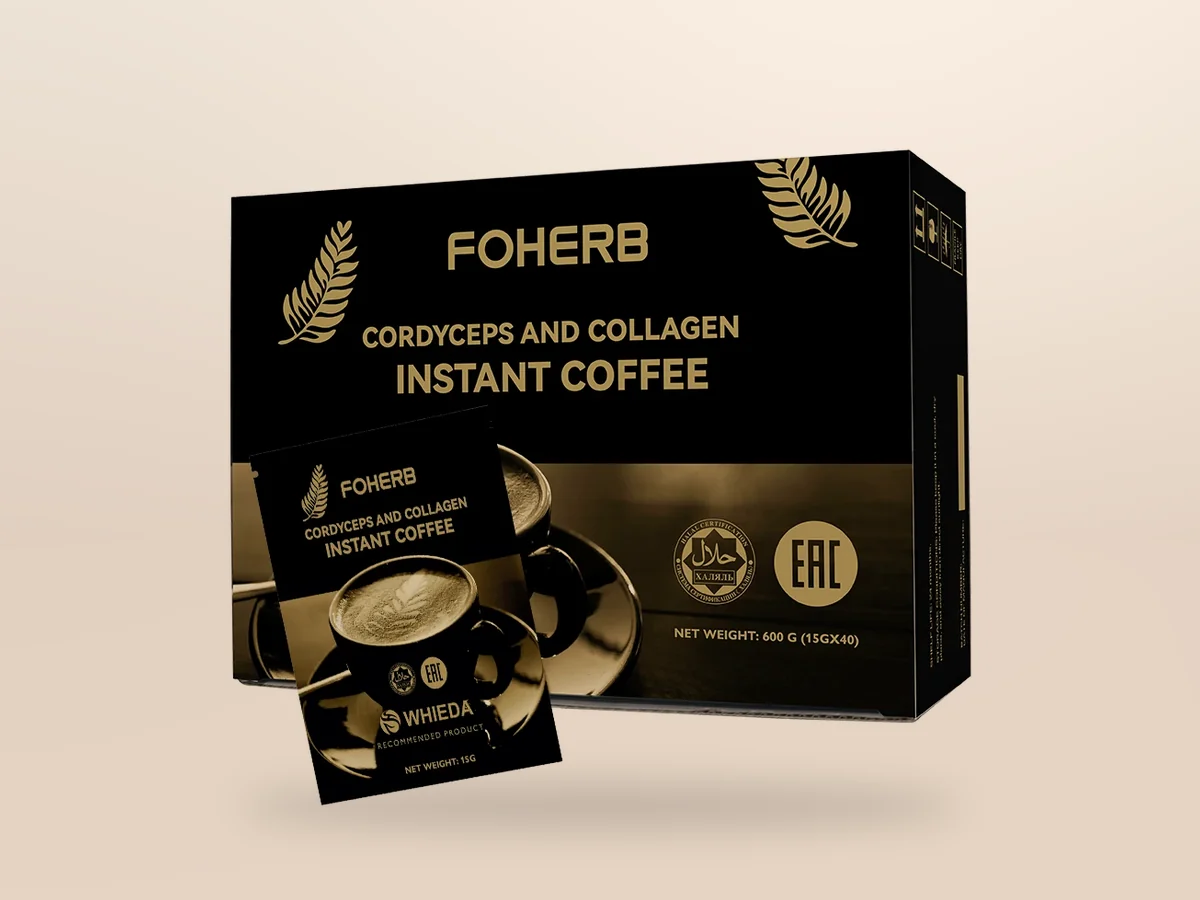
Composition per the official WHIEDA catalog, in the order in which it is listed:
Dry creamer
A creamy taste and a light, “white” color in the cup.
Collagen peptide
Collagen broken down by hydrolysis into short peptides.
Instant coffee powder
The base: it dissolves at once, no coffee pot needed.
Whole milk powder
Milky softness.
Fructooligosaccharide
Soluble dietary fiber, also called a prebiotic.
Cordyceps mushroom powder
The mushroom with the loudest story in this cup.
Sucralose
Sweetness in place of sugar.
Food flavoring
Aroma.
There is no sugar, preservatives or trans fats in the composition. Allergen: milk.
Why a mushroom in the cupCoffee was impossible to get
Which mushroomBirch chaga
TasteEarthy, slightly bitter
Additions—
Where it was madeIn Finland, as a coffee substitute
Document—
Why a mushroom in the cupPeople choose the mushroom themselves
Which mushroomCordyceps powder
TasteCoffee with creamer and milk
AdditionsCollagen peptide and dietary fiber
Where it is madeThe Fohow factory in Tianjin
DocumentEAEU declaration valid until June 4, 2028
The document for the drink — EAEU declaration of conformity N RU Д-CN.РА04.В.40587/23. Under it this is a food product, a coffee drink. It was checked against three technical regulations of the Customs Union: on food safety, on food labelling, and on food additives and flavourings.
The drink is made in Tianjin, in the Baodi district. The Fohow factory has stood there since 2007, with 25,928 m² of production space.
The name “cordyceps” rings loud in China. In 2012, for top-grade wild cordyceps from Tibet, Beijing shops asked twice as much as for the same weight of gold. We told the whole story, with the collectors on their knees and a forty-year price timeline, in the article about the Phoenix Elixir. The Fohow factory has a long relationship with cordyceps: it received a patent for a drinkable liquid with it back in 2016. In the coffee the mushroom comes as a powder, and that is how it is listed in the composition.
Collagen is the most abundant protein in mammals. It accounts for a quarter to a third of all the protein in the body, and skin, tendons and cartilage are built from it (Wikipedia). In the sachet it is already broken down by hydrolysis into short peptides and dissolves in hot water together with the coffee.
We are used to thinking of China as the land of tea. Now look at Pu’er, a city in Yunnan Province whose name belongs to a famous tea. In December 2025 China Daily called Pu’er the largest coffee-growing area in China (China Daily). In 2024 all of Yunnan harvested 146,000 tonnes of coffee, worth almost 5 billion yuan. That is 13% more than a year earlier (China Daily Hong Kong).
We wrote about pu-erh, which ages like wine, in the article about Liuwei tea. Coffee in China stopped being exotic long ago, and mushrooms have been prized there for thousands of years. In the Fohow cup they met.
A study of an ingredient, not of the finished product. In 2005 Japanese scientists gave healthy volunteers gelatin hydrolysate, that is, collagen, on an empty stomach. An hour or two later a peak of collagen peptides appeared in the blood, with the peptide Pro-Hyp the main one. By the fourth hour the level had halved (Iwai et al., 2005). In short: collagen peptides reach the bloodstream.
A study of an ingredient, not of the finished product. A 2021 review gathered 19 double-blind randomized trials, 1,125 people aged 20 to 70, 95% of them women. After 90 days of collagen hydrolysate, skin hydration and elasticity were better than on placebo, and wrinkles were fewer (de Miranda et al., 2021). A 2023 review of 26 trials and 1,721 participants saw the same for hydration and elasticity. The authors call on their colleagues for even larger studies (Pu et al., 2023).
A study of coffee itself, not of the finished drink. A 2017 review in the BMJ brought together 201 meta-analyses of observational studies and 17 meta-analyses of trials. The authors’ conclusion: in usual amounts coffee looks safe and more likely to benefit health than harm it. The biggest gain is at about three to four cups a day versus none. The exception is pregnancy (Poole et al., 2017).
The sachet fits into the ordinary day of a woman with a job, a home and plans of her own:
Her morning starts with coffee
The cup will be there anyway. Let it hold some collagen and a mushroom, too.
Cream yes, sugar no
White coffee with a soft milky taste, sweetened with sucralose.
She wants collagen, but forgets capsules
Coffee you will never forget.
Work, commute, dacha
The sachet is light and lives in your bag; all you need is hot water.

No brewing, no measuring with a spoon, no adding milk. All per the official description:
Sachet into a cup
One sachet, one cup.
150 ml of water, 85 °C
How to measure it without a thermometer is in the questions below.
Stir well
The powder dissolves at once.
Drink it hot
While it is hot, the flavor is richer.
Keep the box in a dry, cool place away from the sun. Shelf life is 24 months.
According to the WHIEDA description — a delicate taste and an exquisite aroma. By composition it is coffee with creamer and whole milk, soft and lightly sweet without sugar.
Childhood, mushroom allergy, lactose intolerance. The drink contains coffee, and therefore caffeine: during pregnancy and breastfeeding, the same rule applies to this cup as to any coffee.
N RU Д-CN.РА04.В.40587/23EAEU declaration
Declaration of conformity for the coffee drink with cordyceps and collagen. A food product, technical regulations TR CU 021, 022 and 029. Valid from June 6, 2023 to June 4, 2028. Open PDF ↗
CN104068379BCordyceps patent
The factory’s patent for a drinkable liquid with fermented cordyceps, shiitake, lingzhi and honey. This is the recipe by which we know the Phoenix Elixir. Filed in 2014, granted in 2016. Open patent ↗
CN120505391AMushrooms and collagen
A 2025 factory application: co-fermentation of medicinal mushrooms and animal proteins, including collagen peptides. Mushrooms and collagen in one piece of work. Open the application ↗
100+Over a hundred patents
More than a hundred patent documents are held by the companies of the group. List on Google Patents ↗
GR202312000548High tech
State certificate of a “high-tech enterprise,” November 2023, from the Tianjin science, finance and tax authorities. Open the scan ↗
WEF Award 2023Innovation
The FOHERB group, which includes the Fohow factory, received the World Economic Forum’s New Champions Award in the “Innovation” category. WEF page ↗
Who is who: the drink is made by the Fohow factory, the box carries the mark of its group FOHERB, and in Russia and the CIS the coffee is sold by WHIEDA.
Is there sugar in the drink?
No. The sweetness comes from sucralose. The composition does include dry creamer and whole milk, so this coffee is not suitable if you are lactose intolerant.
How long does a box last?
The box holds 600 g: 40 sachets of 15 g. One cup a day lasts 40 days, two cups a day last 20.
How do I brew it without a thermometer?
Boil the kettle and let it stand for a few minutes. Pour 150 ml of water over the sachet — a little less than an ordinary cup — and stir well.
Where is this coffee made?
At the Fohow factory in Tianjin. The factory and its address are written into the EAEU declaration. open PDF ↗
Finns drank chaga because there was no coffee. You have coffee, and beside it in the sachet come cordyceps, collagen and creamer.
A box of 40 sachets costs 5,000 ₽. One cup works out to 125 ₽, two cups a day to 250 ₽. Whether the box is in stock right now is shown on the product card.